
Housing Market Effects of Federal Budget 2026
Implications for Australian Property Investors, First-Home Buyers, Renters and Housing Supply
Executive Summary
The 2026 Federal Budget marks a major shift in Australian housing tax policy. From 1 July 2027, negative gearing will be limited to new residential builds, while the 50% capital gains tax discount will be replaced with inflation-based cost-base indexation and a 30% minimum tax rate on capital gains. Existing properties held before 7:30pmAEST on 12 May 2026 are protected from the negative gearing change, and capital gains tax changes apply only to gains accruing after 1 July 2027.
The likely market effect is not a crash, but a re-pricing of investor behaviour. Established investment properties become less attractive on an after-tax cash-flow basis, while new-build properties gain relative tax advantage. REA’s assessment is that home prices may be modestly lower than otherwise, rents may be slightly higher, turnover may shift around the transition period, and new supply gains will depend heavily on whether construction feasibility improves.

1. Core Budget Measures Affecting Housing
The Budget introduces two central housing tax changes.
First, negative gearing for residential property will be redirected toward new builds. Future investors in established residential property will no longer be able to offset rental losses against salary or other non-property income; instead, losses can be carried forward and used against future residential property income or capital gains.
Second, the CGT regime moves away from the fixed 50% discount toward inflation indexation. This means investors will generally be taxed on real gains rather than nominal gains, but high-growth assets may face higher effective tax than under the old discount system.
A critical design feature is grandfathering. Properties held before Budget announcement time remain eligible for existing negative gearing treatment until sold, which reduces immediate market disruption but may create a “lock-in” effect where some investors delay selling.
2. Likely Effects on Property Prices
The most likely price effect is modest downward pressure on established investment stock, especially in suburbs where investor participation is high. REA’s analysis suggests long-term prices may be around 1% to 5% lower than they otherwise would have been, rather than materially lower in absolute terms.
This impact should be uneven. Affordable units, outer-ring investor suburbs, student rental markets, and high-yield investor corridors are more exposed than premium owner-occupier suburbs. The reason is simple: when tax benefits fall, investors reduce the price they are willing to pay unless rent, depreciation, growth expectations or borrowing conditions compensate.
3. Effects on First-Home Buyers
First-home buyers may benefit from reduced investor competition for established homes. Treasury expects around 75,000 additional first-home buyers over a decade as some homes shift from investors to owner-occupiers.
However, this is not a universal affordability solution. A buyer still needs borrowing capacity, deposit savings, stable income and suitable stock. If mortgage rates, insurance, strata costs or living costs remain high, tax reform alone will not solve entry barriers.
4. Effects on Renters
Renters are the most exposed group. The rental market was already tight before the reform, with REA reporting rental affordability at its weakest level in two decades and a typical-income household able to afford only 37% of advertised rentals in the second half of 2025.
The Budget’s logic is that some renters become owners, reducing rental demand as rental supply falls. That may hold at the national aggregate level, but local markets can behave differently. Inner and middle-ring suburbs with strong renter demand but limited new supply may see sharper rental pressure if investor ownership declines there.
5. Effects on New Housing Supply
The reform favours new housing, but the supply response is uncertain. New builds can continue to access negative gearing, and investors in new homes can choose between the existing CGT discount and indexation.
This should improve demand for off-the-plan apartments, townhouse projects and genuine additional dwellings. However, REA and Budget material both point to a larger constraint: feasibility. Construction costs, labour shortages, finance costs, planning delays and zoning restrictions may limit the ability of tax incentives to generate enough new dwellings.

6. Investor Strategy Implications
For investors, the post-Budget market requires a new decision framework:
1. Tax status: Is the property grandfathered, new-build eligible, or post-reform established stock?
2. Cash-flow resilience: Can the property hold itself without salary-offset tax relief?
3. Exit-tax modelling: Does indexation produce a better or worse outcome than the old CGT discount?
4. Local rental depth: Is demand broad enough to absorb policy-driven supply shifts?
5. Supply pipeline: Is the suburb exposed to oversupply, or protected by land scarcity and planning constraints?
The old strategy of buying negatively geared established property primarily for tax relief becomes weaker. The stronger strategy is to buy assets where the investment case survives without tax sheltering.
7. Original Teaching Model: The 4-Market Impact Map
A practical way to teach the Budget impact is through four connected markets:
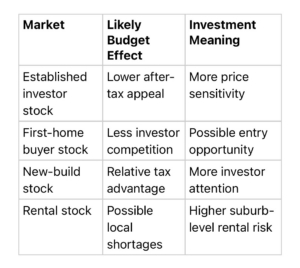
The key insight: the Budget does not affect “property” as one market. It changes the relative attractiveness of different property types.
8. Strategic Conclusion
The 2026 Federal Budget is best understood as a capital reallocation policy. It nudges investors away from established dwellings and toward new supply. It may modestly support first-home buyers and slightly soften established-property prices, but it also increases risk for renters in areas where investor stock falls and new supply cannot replace it.
For property investors, the winning approach is no longer simply “buy, negatively gear, and wait.” The post-Budget investor needs stronger due diligence, suburb-specific rental analysis, tax-aware cash-flow modelling, and a sharper distinction between established assets and genuine new supply.
Bottom line: the Budget may improve fairness at the margin, but housing affordability will still depend mainly on supply, planning reform, infrastructure delivery, construction capacity and borrowing conditions.
References:
- Australian Federal Budget 2026 – Housing Tax Explainer
- Australian Federal Budget 2026 Official Website
- How the Budget Tax Changes Will Affect Housing Markets – realestate.com.au
- REA Group Market Insight – Effect of Budget Housing Taxes
- REA Group Rental Affordability Report 2026
- Reserve Bank of Australia Research Discussion Papers
- Australian Housing and Urban Research Institute (AHURI)
- CoreLogic Australia Research
- Property Council of Australia – Policy & Advocacy
- ATO – Capital Gains Tax Guidance
- ATO – Rental Property Guide
- Housing Australia (NHFIC)
- Productivity Commission – Housing Construction Research
- ABS Residential Property Price Indexes
- Reserve Bank of Australia – Financial Stability Review